Spain has more than 22,000 community pharmacies. One for every 2,100 inhabitants — one of the densest networks in Europe. The pharmacy is, by far, the most frequently visited healthcare access point: no appointment needed, located on every high street, and attending to the chronic patient with a regularity that no other healthcare professional can match.
Yet the vast majority of this relationship still operates on a dispensing model: the patient arrives, collects their medication, and leaves. The knowledge the pharmacist accumulates about that patient — what they take, since when, how often they collect — remains trapped in disconnected systems or, in many cases, in the professional's own memory. Digital transformation is not about replacing that with a screen. It is about freeing that knowledge so it can generate real clinical value.
From dispensing to caring: an evolution of decades
The idea that the pharmacy can be something more than a dispensing point is not new. The concept of pharmaceutical care was formalised in the 1990s. In Spain, the Pharmaceutical Care Forum in Community Pharmacy — driven by CGCOF (General Council of Official Colleges of Pharmacists), SEFAC (Spanish Society of Family and Community Pharmacy) and other bodies — has spent years defining Professional Pharmaceutical Care Services (SPFA): pharmacotherapeutic follow-up, medication use review, health education, pharmacist-led indication.
These services exist. They are described, practice guidelines exist, training is available. What has been lacking, in many cases, is the infrastructure to scale them. A pharmacist can conduct pharmacotherapeutic follow-up of 20 patients with paper records. But not 200. And without scalability, the impact remains limited to individual commitment.
The pharmacy as a health data centre
Consider what the pharmacy already knows. Every time a patient collects a prescription, the system records which medicine has been dispensed, in what quantity, and when it was last collected. If someone should have collected their antihypertensive three weeks ago and has not done so, the pharmacy is the first to detect it.
But that information rarely turns into action. Pharmacy management systems are designed for billing and stock control, not for clinical follow-up. The data exists, but it does not generate an alert. It does not trigger a call. It does not open a communication channel with the patient.
Technology in the service of the pharmacist, not the other way around
There is a real risk in digital health: that technology becomes an end in itself. In the context of community pharmacy, technology only makes sense if it solves concrete problems for the professional:
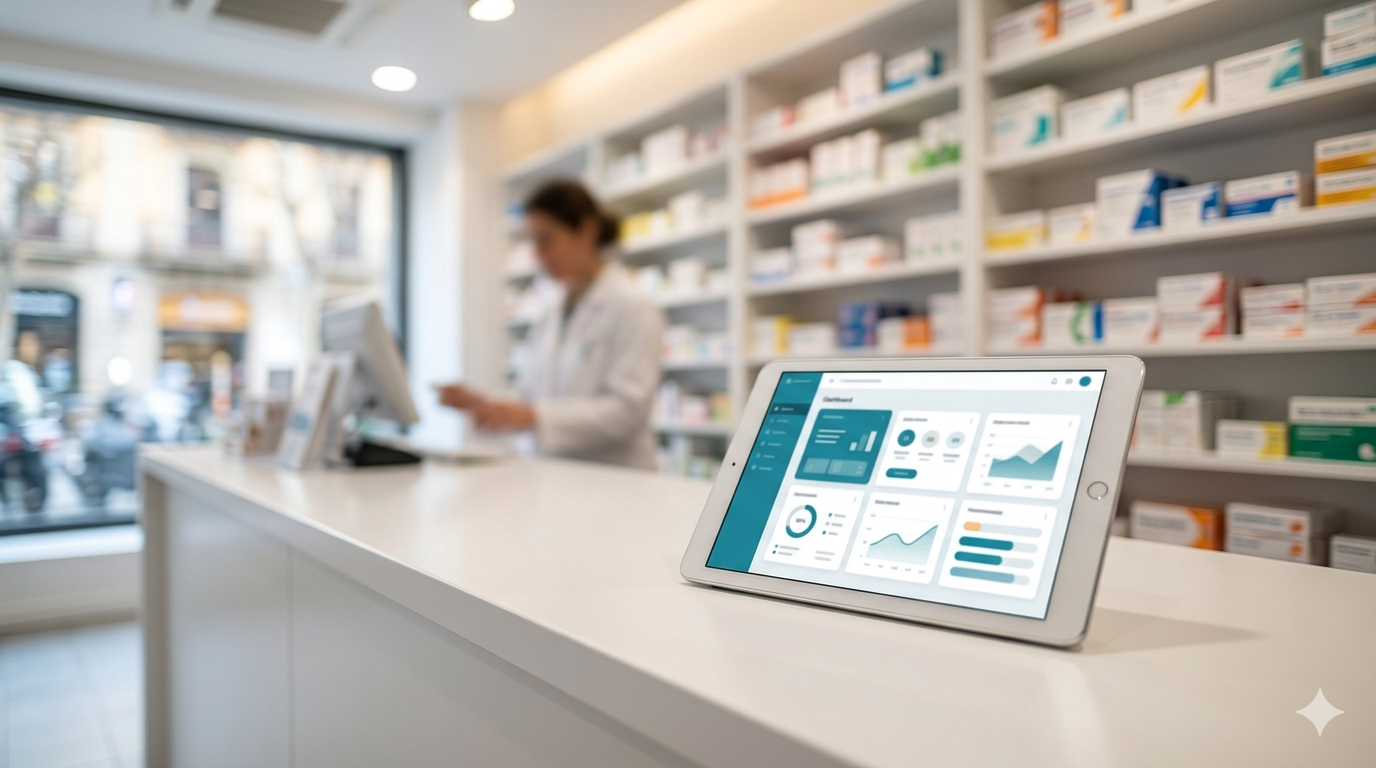
Real-time visibility. Which patients are taking their medication correctly? Who has not logged a dose for days? A follow-up dashboard showing this information turns passive data into opportunities for intervention.
Direct communication. A patient has a question about their medication at 9 in the evening? An integrated messaging channel allows the query to be resolved before the patient makes a decision on their own — such as stopping a drug because of a side effect they find worrying.
Automatic alerts. If a patient with diabetes has not logged doses for three consecutive days, or if their stock of a critical medication is nearly exhausted, the system can alert the pharmacist without them having to review each patient manually.
Prescription management. Creating, modifying and tracking prescriptions from a centralised interface, with visibility of doses, frequencies, start and end dates, and the adherence status of each medication.
Post-dispensing follow-up: the missing link
We have analysed this in detail in our article on why adherence fails: the most critical moment is not the prescription or the dispensing, but what happens afterwards. When the patient arrives home with their pharmacy bag, they are left alone facing their treatment.
The lack of post-dispensing follow-up is the main modifiable factor in therapeutic adherence. And the community pharmacy is the natural agent to address it, because it already has the relationship with the patient. What it needs are tools that allow that relationship to remain active between visits.
This is not about monitoring the patient. It is about accompanying them. So that when they have a question, the answer is a message away. So that when they miss a dose, someone detects it. So that when a treatment is not working, it is identified in time.
The measurable impact
The evidence supports this model. Meta-analyses published in journals such as The Annals of Pharmacotherapy and BMC Health Services Research show that pharmacist-led interventions improve adherence by between 10% and 30%, depending on the condition and the intensity of the intervention. The specific figures matter: as we detail in our article on adherence in Spain, every percentage-point improvement in adherence translates into hospitalisations avoided and costs reduced.
Personalised Dosing Systems (PDS) — blister packs prepared individually by the pharmacy — have been shown to reduce medication errors by between 50% and 80% in polymedicated patients. And when combined with digital follow-up, results are even better, because the professional can verify whether the patient is actually taking the prepared medication.
Connecting pharmacy, patient and caregiver
The most effective model is not a line between two points, but a triangle. The pharmacy cares for the patient. But in many cases — especially with elderly or dependent people — there is an essential third actor: the family caregiver.
When the pharmacy can communicate with the caregiver, share the adherence status, send alerts when something is wrong, and receive feedback on how the patient is progressing, the care system becomes much more robust. The caregiver is no longer alone. And the pharmacy gains information it would otherwise not have.
Conclusion
The Spanish community pharmacy has an advantage that no other healthcare agent possesses: constant proximity to the chronic patient. Digital transformation does not change that advantage; it multiplies it.
The pharmacy of the future is not the one with the most technology. It is the one that uses technology to do what it has always done — care — but in a continuous, scalable way, connected to the rest of the patient's care system.
References
CGCOF (General Council of Official Colleges of Pharmacists) — Statistics on the pharmacy network in Spain SEFAC (Spanish Society of Family and Community Pharmacy) / Pharmaceutical Care Forum — Professional Pharmaceutical Care Services (SPFA) WHO — The Role of the Pharmacist in the Health Care System (1994) Community pharmacy study in Spain (Int. J. Environ. Res. Public Health, 2021)FarmaClar offers pharmacies a digital platform for patient monitoring, prescription management and direct communication.
Request info →